

Teaching and Learning Cycle

Teaching and Learning Cycle

What is the teaching and learning cycle?

If you’re just beginning your journey into the new world of adult education, then you’re going to need to get used to an awful lot of new language.

Eventually you’ll know the teaching and learning cycle – sometimes referred to as the TLC – like the proverbial back of your hand. The same will go for its five stages, right from Identifying Learning Needs through to Evaluate and Quality Assure.

But for now, let’s assume that if you’re reading this then you’re at the very beginning of your adult education journey and go right back to basics. Let’s get started.
What does the term “Teaching and Learning Cycle” mean?

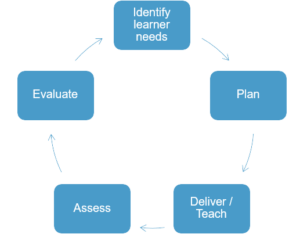
When we use the phrase Teaching and Learning Cycle, we are talking about an endlessly repeatable cycle which you will use in your teaching career and which consists of five steps, from getting to know your pupils, right through to looking at how well you have delivered your teaching.

Regarding the origin of the phrase itself, scholars disagree about who coined it first, but most agree that John Dewey is the father of the TLC, having come up with a five-step process back in 1933.

Other names usually mentioned are those of Kolb and Fry, who pioneered the four-step experiential learning model some 40 years after Dewey. We must also remember Peter Honey and Alan Mumford’s pioneering 1986 work on learning styles, which continues to be hugely influential today.

Although the cycle itself bears repeated use, certain elements will be different each time, some changing dependent on your pupils and some improving as you assess where you could have better helped your learners.

The five phases or steps of the cycle are as follows:

  • Identifying learning needs
  • Planning your learning
  • Delivering teaching and aiding learning
  • Assessing learning
  • Evaluating and quality assurance

A teacher or trainer has responsibilities in each stage, and also overarching responsibilities throughout the whole of the cycle.  One thing that affects, or is involved in every stage, is quality assurance (QA), and it is the strict processes that teachers / trainers, centres (including Authentic Training), and awarding organisations follow in the implementation of QA that have created an adult education sector that is respected throughout the world.

In the next section, we will go into more detail about each step.

Identifying Learning Needs

Otherwise known as the assessment phase, identifying your learners’ needs is as crucial a step as any in the entire process.

This stage will help you identify what kind of people your learners are, what kind of learners your people are, whether they have any kind of specific learning needs, and whether they want or need to get anything in particular from the teaching you are about to deliver.

There are various ways in which you can go about discovering all of this. Whereas a school teacher will most likely have exam results and previous teachers’ comments to work with, as an adult education teacher or tutor you won’t be so fortunate.

However, tried and tested methods include formally interviewing your students – you may choose to use Honey and Mumford’s learning style questionnaire – or you may find that a more relaxed approach – having a simple conversation with your students – works better for all concerned.

It’s first in our list because it’s traditionally placed at the beginning of the cycle, but, like the cycle itself, it will be constantly evolving as you get to know your students better.

Planning

As good a test as any as to whether teaching is the career for you, the planning stage of the cycle is where we use what we have learned in the first phase to plan our lessons.

If you relish this part – creating hand-outs, deciding which videos would be best to use and writing your final lesson plans – then the chances are that you will enjoy life as a teacher.

However, if the idea of putting together multiple choice questionnaires (MCQs, another new acronym to get your head around) and working out ways to assess your students’ learning further down the line fills you with dread, then teaching might not be the career for you.

In terms of actually doing the planning, you might find it best to work backwards: think of what you want to achieve from each lesson, and then devise the steps that will best take your learners towards that goal.

Although it may be daunting, another useful tip is to plan a group of lessons all at once – that way you will be able to chart the progress you want your learners to make across several weeks.
 

LEVEL 3 AWARD IN EDUCATION & TRAINING COURSE (PTLLS) – ONLINE + ZOOM
LEVEL 3 AWARD IN EDUCATION AND TRAINING (PTLLS) – 3 DAY FAST CLASS
LEVEL 3 AWARD IN EDUCATION AND TRAINING (PTLLS) – 5 DAY FAST TRACK

Delivering teaching and aiding learning

Rather like the film-making phrase “lights, camera, action!”, the third part of the Teaching and Learning Cycle is where the whole thing is put into practice.

This might be the part you’ve been looking forward to; alternatively it might be the part where you take a deep breath, swallow your fears and jump in feet first. If the latter sounds more like you, then don’t be unduly concerned – even the most confident of teachers started somewhere and the vast majority were nervous at the start.

Delivery is also a phase which is impacted by and impacts upon your previous two elements. Back in 1991, Donald Schön came up with his reflection-in-action theory, which expanded on teachers’ natural inclination to take note of what was and wasn’t working for their learners during a lesson itself and changing it there and then.

As Schön observed, this is a hugely effective way of adapting your techniques and improving your outcomes as it allows you to react and make the necessary changes immediately rather than afterwards.

Assessing learning

The fourth part of the teaching and learning cycle is assessment. As Dr Cheryl A Jones observed in her pioneering 2005 work on assessment for learning, “assessment as part of classroom activities is a fundamental process required to promote learning and ultimately achievement.”

Dr Jones went on to observe that in order for the assessment to be successful, you as a teacher need to ensure that students understand the aim of the learning, why they are learning it, how well they are doing and how they can get better and reach their targets.

In their work on Assessing and Monitoring Pupil Progress, the Education Endowment Foundation broke it down into four areas to ensure that, however it is delivered, the assessment is effective. The four areas are

  • Does the assessment measure what it is intended to?
  • Are the assessments carried out regularly?
  • Does the assessment positively affect the students’ learning?
  • Do the students understand the point of the assessment?

Your method of assessing your students’ learning might be as simple as setting tests for them to take, but there are, naturally a number of other ways if exams aren’t suitable.

These might include asking students to:

  • Write assignments
  • Create presentations, posters and more
  • Engage in discussions in person on online

If tests and exams suit your subject but not your students, mix things up by using multiple choice exams, the likes of Quizlet, Kahoot or relative newcomers Outgrow.

The above methods of assessment lead onto the trainer’s next responsibilities:

  • Mark or assess the work
  • Feed back to the student
  • Negotiate the next steps with the student / set targets for progression

Evaluation and quality measurement

The fifth and final stage of the Teaching and Learning Cycle is evaluation.

Engaging with your students is vital in order to gauge the effectiveness of what you have been teaching them: what has worked, what hasn’t, what you could do better at and what needs changing completely.  Some of the questions you may want to ask the students are:

  • How effective was your teacher?
  • How would you rate the environment?
  • What did you like about the course?
  • What did you not like?
  • What would you change?

Some of the questions you may want to ask yourself as the teacher are:

  • How many students started the course?
  • How many learners finished the course?
  • How many – if any – were dissatisfied with the course?
  • What would I do differently next time?

Dependent on your students, you might find that face-to-face conversations work best in terms of methodology; these can be conducted on a one-to-one basis or in groups.

That said, some tutors have found that online polls on the likes of SurveyMonkey, Google Forms or Jotform are more accurate in terms of evaluation, as some students are more likely to be honest when giving feedback in private and/or anonymously than they are in a face-to-face setting.

However you collect your information, doing it immediately after delivering the training is best as the course is still fresh in their minds and it allows you time to implement changes into your teaching straight away.

We hope you have found this short guide to the Teaching Learning Cycle useful.

If you’re looking to pursue a career in adult education, we’d love to talk to you about the Level 3 Award in Education and Training course – the only qualification you need to teach adults in the UK.

To give us a call and speak to one of our expert trainers, ring 0151 546 5151 and ask for John or Kris.

Alternatively, send us an email at info@aet1.dohostinguk.com and we’ll get back in touch as soon as we can.

LEVEL 3 AWARD IN EDUCATION & TRAINING COURSE (PTLLS) – ONLINE + ZOOM
LEVEL 3 AWARD IN EDUCATION AND TRAINING (PTLLS) – 3 DAY FAST CLASS
LEVEL 3 AWARD IN EDUCATION AND TRAINING (PTLLS) – 5 DAY FAST TRACK
No Comments

Sorry, the comment form is closed at this time.